GST Input Tax Credit (ITC) Reconciliation: A Complete Guide for Businesses
Introduction
Goods and Services Tax (GST) has become an important part of financial management for businesses in India. One of the most valuable features of the GST system is Input Tax Credit (ITC), which allows eligible businesses to claim credit for GST paid on purchases used for business purposes, subject to applicable conditions.
However, claiming ITC is not simply a matter of recording purchase invoices in accounting software. Businesses must ensure that their purchase records, supplier information, tax invoices, and GST returns are properly reviewed and reconciled.
GST Input Tax Credit reconciliation helps businesses identify discrepancies, improve tax accuracy, and reduce the risk of incorrect credit claims. A systematic reconciliation process is therefore essential for effective GST compliance.
What Is GST Input Tax Credit (ITC)?
Input Tax Credit refers to the credit of eligible GST paid on business purchases that can be used to offset GST payable on outward supplies, subject to the provisions of the GST law.
For example, if a registered business purchases office equipment and pays GST on the purchase, it may be eligible to claim ITC if the transaction satisfies the applicable legal conditions.
ITC helps prevent the cascading effect of taxes and supports the smooth flow of credit through the supply chain.
However, not every purchase qualifies for ITC. Businesses must consider eligibility requirements, restrictions under Section 17 of the CGST Act, applicable documentation rules, and other relevant provisions.
What Is GST ITC Reconciliation?
GST ITC reconciliation is the process of comparing a business’s purchase records and input tax details with information available in GST records, particularly the relevant details in GSTR-2B.
The purpose is to verify whether the credit recorded in the books is supported by the available GST information and whether the credit is eligible under the law.
During reconciliation, businesses may identify missing invoices, differences in taxable values, incorrect GSTINs, duplicate entries, supplier reporting issues, or credit that requires further verification.
Regular reconciliation allows these issues to be investigated before they create larger compliance problems.
Why Is ITC Reconciliation Important?
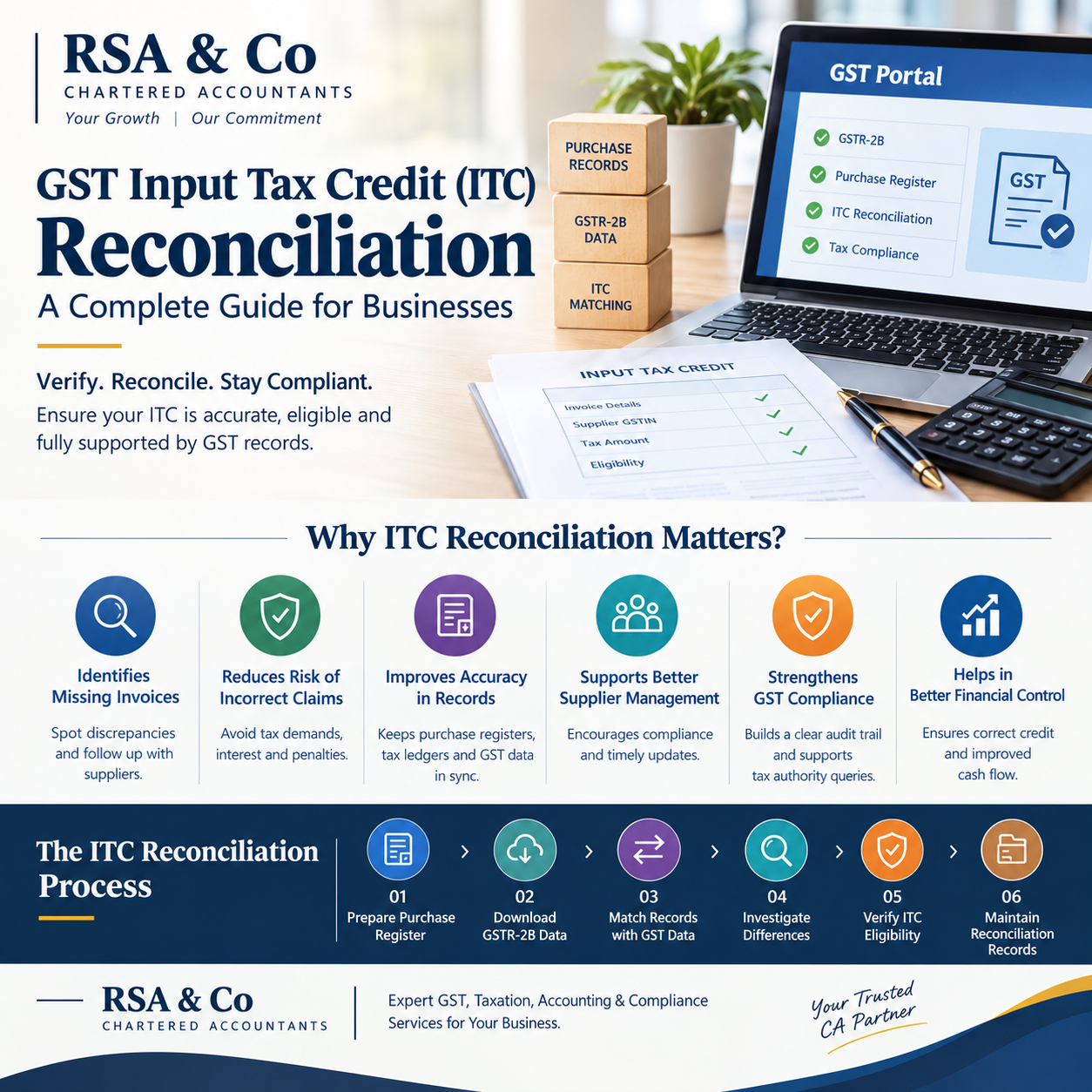
1. Helps Identify Missing Invoices
Sometimes, a supplier may not report an invoice correctly or may report it in a different tax period. As a result, the invoice may not appear in the expected GST records.
Reconciliation helps businesses identify such differences and follow up with suppliers to correct reporting issues where necessary.
2. Reduces the Risk of Incorrect ITC Claims
Claiming ineligible or unsupported ITC may lead to tax demands, interest, penalties where applicable, and additional compliance work.
Reviewing purchase invoices and GST records helps businesses identify credit that should not be claimed or that requires further verification before being included in a return.
3. Improves Accuracy in Financial Records
Differences between accounting records and GST data can affect tax calculations and financial reporting.
A proper reconciliation process helps maintain consistency between purchase registers, tax ledgers, and GST return information.
4. Supports Better Supplier Management
Supplier compliance can directly affect the availability and verification of purchase-related GST information.
By identifying invoices that have not been reported or contain incorrect details, businesses can communicate with suppliers and encourage timely correction of errors.
5. Strengthens GST Compliance
A documented reconciliation process creates a clear record of how ITC has been reviewed and verified.
This can help businesses respond more effectively to questions from tax authorities, subject to the completeness and accuracy of the supporting documentation.
Common ITC Reconciliation Issues
Businesses may encounter several discrepancies during reconciliation, including:
- Invoice Missing in GSTR-2B: Purchase invoices recorded in the books may not appear in the relevant GST statement.
- GSTIN Errors: Incorrect supplier GST identification numbers can create mismatches.
- Tax Amount Differences: GST amounts in the purchase register may differ from the information reported by suppliers.
- Duplicate Invoice Entries: The same invoice may accidentally be recorded more than once.
- Ineligible ITC: Certain purchases may fall under restrictions or blocked-credit provisions.
- Timing Differences: Transactions may be recorded in different periods in the accounting records and GST statements.
Each discrepancy should be investigated individually rather than automatically treated as eligible or ineligible credit.
Steps to Perform GST ITC Reconciliation
Step 1: Prepare the Purchase Register
Collect purchase invoices, debit notes, credit notes, and other relevant supporting documents for the period being reviewed.
Ensure that supplier GSTINs, invoice numbers, dates, taxable values, and tax amounts are recorded accurately.
Step 2: Download the Relevant GST Data
Obtain the applicable GSTR-2B information from the GST portal for the relevant tax period.
GSTR-2B is an important reference for ITC reconciliation, but its appearance alone does not establish that every credit is legally eligible.
Step 3: Match Purchase Records With GST Data
Compare invoice details in the purchase register with the corresponding information in GSTR-2B.
Identify matched invoices, missing entries, duplicate records, and differences in taxable values or tax amounts.
Step 4: Investigate the Differences
Review each mismatch to determine its cause. Contact suppliers where corrections or clarifications are required, and verify the relevant documents and legal conditions.
Step 5: Verify ITC Eligibility
Before claiming credit, confirm that the applicable statutory conditions are satisfied and that no relevant restriction or blocked-credit provision applies.
Step 6: Maintain Reconciliation Records
Document the differences identified, corrective actions taken, supplier follow-ups, and the final treatment of each item.
Maintain these records with supporting documents for future reference and compliance purposes.
Best Practices for Businesses
Businesses can improve their ITC reconciliation process by performing reviews regularly, maintaining accurate purchase records, communicating with suppliers, using reliable accounting software, and assigning clear responsibility for GST compliance.
It is also important to monitor applicable statutory deadlines and restrictions on claiming ITC, as the treatment of a transaction may depend on the relevant financial year and legal provisions.
How RSA & Co Can Help
RSA & Co can assist businesses with GST ITC reconciliation, review of purchase records, identification of discrepancies, verification of supporting documents, and guidance on applicable GST compliance requirements.
Professional assistance can help businesses establish a more structured reconciliation process, improve record accuracy, and address potential issues in a timely manner.
Conclusion
GST Input Tax Credit reconciliation is an important practice for businesses seeking accurate tax records and effective compliance management. By regularly comparing purchase records with GST data and verifying credit eligibility, businesses can identify discrepancies early and reduce the risk of incorrect claims.
A consistent reconciliation process supports better financial control, stronger supplier coordination, and more reliable GST reporting.
RSA & Co provides professional GST, taxation, accounting, and compliance advisory services to support businesses in managing their tax responsibilities effectively.